
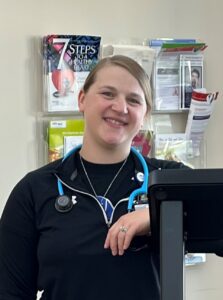
Osmond General Hospital now offers Respiratory Therapy services and a Pulmonary Rehabilitation program that combines lung function diagnostics, exercise programs, and education that will aid patients who struggle with shortness of breath and other breathing problems.
The goal for patients who participate in Pulmonary Rehabilitation is primarily to improve quality of life. We will achieve this by:
- Education on how to control anxiety related to shortness of breath.
- Teach breathing techniques that help manage shortness of breath.
- Improve exercise tolerance and one’s ability to perform day to day activities without getting short of breath.
- And ultimately, reduce the need for hospitalization.
Once a patient becomes conditioned, they can feel more confident in performing day to day activities. Endurance and strengthening of muscles will be beneficial to the patient and help them feel better and have less anxiety and fears of becoming short of breath.
A Respiratory Therapist (RT) also performs and analyzes diagnostic function tests to assess lung capacities and capabilities. We work close with physicians and nurses to help create a treatment plan specific for the patient to help improve their quality of life. We treat patients with aerosol medications and chest physiotherapy and evaluate the progress of the treatments. We offer services that involve setting up patients with home oxygen, conducting overnight pulse oximeter tests, apply holter monitors to gather extended heart rhythms, and perform Pulmonary Function Tests and 6-minute walk tests.
With the addition of the MiniBox+®, pulmonary function testing (PFT) can be completed onsite within a comfortable setting. The MiniBox+ is a portable PFT machine that does not require a sit-in chamber, so there is no sensation of claustrophobia as with traditional PFT machines. The PFT test will help diagnose obstructive and restrictive lung diseases. This test is a noninvasive test that shows how well the lungs are working. The test will measure lung volume, capacity, rates of flow, and gas exchange. This information will help your provider diagnose lung conditions and help make sure that you as a patient are getting the appropriate treatment. Your provider may order a PFT study to help diagnose health problems such as allergies, respiratory infections, trouble breathing from injury to the chest, asbestosis, sarcoidosis, scleroderma, scoliosis, tumors or inflammation or scarring of the lungs.